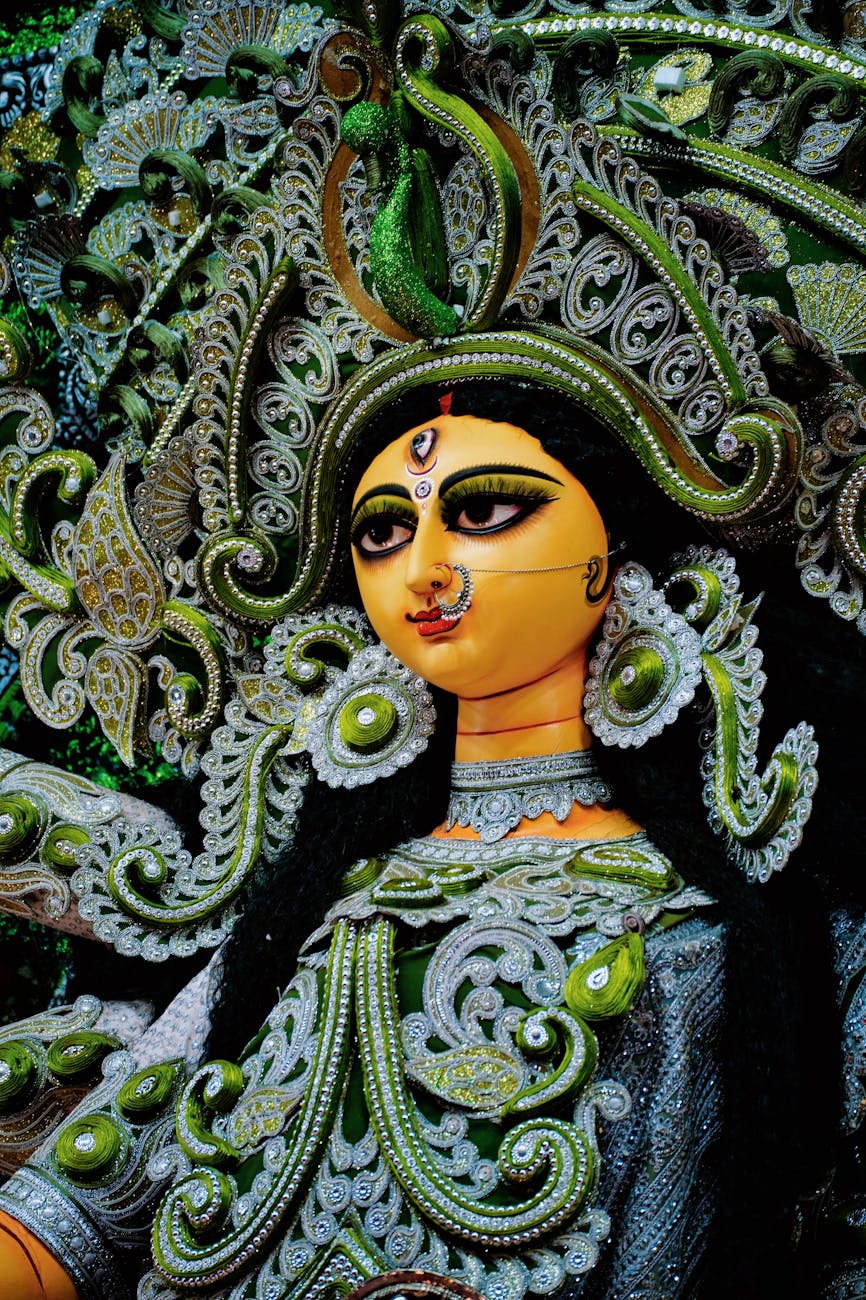
Mythology behind Durga Puja
‘The hangover of Durga Puja is still not over. Yes, Durga Puja, one of the most significant festivals in Hindu tradition, is widely regarded as a grand socio-cultural celebration. But its roots lie deeply in mythology. The mythology behind Durga Puja is layered with multiple legends drawn from ancient texts, regional retellings, and symbolic interpretations. From the slaying of the buffalo demon Mahishasura to Rama’s akal-bodhan or “untimely awakening” of the goddess, the festival represents the eternal triumph of good over evil, devotion over arrogance, and divine order over chaos. As we concluded the celebrations of Durga Puja today, let us immerse ourselves in the mythology behind Durga Puja.
The Slaying of Mahishasura
The central mythology behind Durga Puja originates in the Devi Mahatmya, a part of the Markandeya Purana (5th–6th century CE). This text narrates how Mahishasura, a powerful buffalo demon, acquired a boon from Brahma after years of penance. His boon stated that no man or male deity could defeat him. Drunk with arrogance and power, Mahishasura launched an assault on the heavens, defeated the gods, and established himself as the ruler of the cosmos.
Helpless before his strength, the gods approached the holy trinity, Brahma, Vishnu, and Shiva, for help. Out of their combined divine energies, a radiant warrior goddess was created: Durga, also called Mahishasura Mardini (“slayer of the buffalo demon”). Each deity bestowed their weapons and powers upon her: Shiva’s trident, Vishnu’s discus, Indra’s thunderbolt, Varuna’s conch, and many more. Mounted on a fierce lion, she became the embodiment of Shakti, the feminine cosmic energy.
The mythology describes how Mahishasura, a master of shape-shifting, fought ferociously with Durga for nine nights and ten days, assuming various forms, a lion, an elephant, and finally his buffalo form. Yet, Durga relentlessly pursued him and, on the tenth day, beheaded him with her sword. This day is commemorated as Vijaya Dashami, the day of victory, symbolizing the goddess’s triumph over demonic forces.
This story is not just a tale of battle but a symbolic representation of the destruction of ignorance, ego, and adharma (unrighteousness). Mahishasura represents the destructive instincts within humans, while Durga signifies the awakened power of the divine feminine, capable of restoring balance to the universe.

Rama’s Akal Bodhan
Another widely cherished mythology behind Durga Puja comes from the Ramayana, particularly its Bengali retelling by the 14th-century poet Krittivas. Traditionally, Durga was worshipped in the spring during Vasanta Puja. However, according to this version of the Ramayana, it was Prince Rama who initiated the autumnal worship of the goddess before his battle with Ravana, the demon king of Lanka.
As the story goes, when Rama struggled to defeat Ravana and his mighty brother Kumbhakarna, he sought the blessings of Goddess Durga. He decided to perform a special invocation or bodhan during the month of Ashwin (September–October), which was considered “untimely” or akal since the ritual was traditionally performed in spring. Hence, this episode became famous as akal-bodhan.
Rama prepared 108 blue lotuses and 108 lamps as offerings, but when he found himself one lotus short, he resolved to pluck out one of his own eyes, since he was also called Kamalnayan (lotus-eyed). Pleased with his devotion, Durga restored the missing lotus, blessed Rama, and granted him victory. On the tenth day, Rama finally slew Ravana, and thus Vijaya Dashami came to symbolize not only Durga’s triumph over Mahishasura but also Rama’s victory over Ravana.
This myth adds another dimension to the mythology behind Durga Puja. The festival becomes a celebration not just of divine power but also of human devotion and unwavering faith.

The Goddess as Daughter
Alongside the warlike legends, there is also a softer and more familial mythology behind Durga Puja. In Bengal and other parts of eastern India, Durga is also regarded as a daughter returning to her maternal home during the festival. Popular belief holds that during these days, she travels from her abode in Mount Kailash, where she resides with Shiva, to her parents’ home, accompanied by her children, Ganesha, Kartikeya, Lakshmi, and Saraswati.
This narrative adds an emotional and cultural layer to the mythology behind Durga Puja. The festival is seen as a homecoming, where devotees welcome the goddess like a beloved daughter visiting her family. The immersion (Visarjan) of her idol at the end of the festivities symbolizes her departure back to her divine home, leaving her devotees in both joy and sorrow.

Durga in the Skanda Purana
The Skanda Purana presents yet another strand of mythology behind Durga Puja. The goddess Parvati, consort of Shiva, acquires the name Durga after slaying the demon Durgama. This myth underscores her identity as both a fierce warrior and a universal mother. She is also seen as Prakriti (nature), embodying the three gunas: sattva (balance and wisdom), rajas (activity and passion), and tamas (inertia and ignorance).
Her various forms, Mahakali, Mahalakshmi, Mahasaraswati, and Chandi, are invoked during the festival, each with a distinctive role in the cosmic cycle of creation, preservation, and destruction. This dimension of the mythology reminds devotees that she is not only a destroyer of evil but also the creative energy sustaining the universe.

Symbolism of Durga’s Form
Durga Puja is incomplete without understanding the symbolism of the goddess’s depiction. Every aspect of her iconography conveys profound meaning:
Ten Arms represent her ability to protect devotees from all directions. The three eyes, like Shiva, Durga is Triyambake, her left eye symbolizes desire (moon), her right eye represents action (sun), and her central eye stands for knowledge (fire). The lion, as her vehicle, symbolizes willpower, courage, and determination; the lion shows Durga’s mastery over these qualities.
The weapons, including the conch shell, signify the cosmic sound Om. Bow and arrow symbolize potential and kinetic energy. Thunderbolt stands for firmness and conviction. Lotus denotes unfolding spiritual consciousness. Sudarshan Chakra symbolizes universal order under her control. The sword represents sharp knowledge. Trishul embodies the three gunas and her power to remove all types of miseries.
Through this iconography, the mythology behind Durga Puja reinforces the idea that the goddess is not merely a warrior figure but the embodiment of ultimate wisdom, power, and compassion.

Ancient texts also provide vivid descriptions of Durga’s battle with Mahishasura. The goddess, in her fierce form as Ambika or Chandika, annihilated Mahishasura’s vast armies. Demons such as Chiksura, Chamara, Udagra, Baskala, and Mahahanu fell before her weapons. Her lion mount tore through enemy ranks, while sages and gods praised her relentless strength.
The mythology behind Durga Puja thus portrays not just the slaying of one demon but a cosmic cleansing, where evil forces in various forms are subdued. This magnifies her role as both protector and restorer of balance in the universe. The mythology interweaves multiple traditions, each offering a different lens to view the goddess and her worship.
At its core, Durga Puja emphasizes the eternal victory of righteousness over arrogance, light over darkness, and truth over illusion. Across centuries, this festival continues to inspire millions, not only as a religious observance but also as a cultural expression of resilience, unity, and faith in the protective power of the Divine Mother.

Author
Aparupa Roy
A college student who loves History and enjoys her own company. She loves to read books and has a special fascination for paintings, doodling, and dancing.


